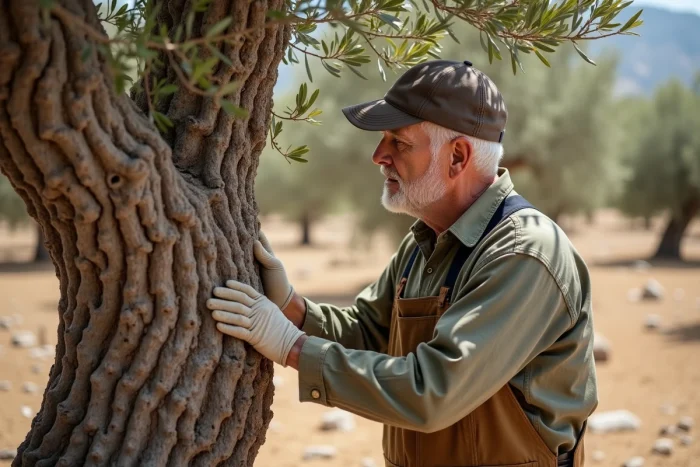
An olive tree can survive prolonged drought periods without showing obvious signs of weakness, but some subtle clues indicate advanced, often irreversible damage. There are cases where leaves persist on a tree that is already doomed.
Watering errors or unsuitable soil can sometimes accelerate a decline that is wrongly attributed to pests. Regular observation and knowledge of the symptoms allow for quick action to limit damage or attempt recovery.
Recognizing a struggling olive tree: signs not to ignore
In the olive tree, signs of distress are first visible in the foliage. A healthy tree displays green, supple, and shiny leaves. As soon as they become dry, brittle, or fall en masse outside of winter, the danger becomes clear. Sudden leaf drop in spring or summer often betrays a problem at the root level, or acute thirst that the tree can no longer satisfy.
To refine this observation, examine the branches. A healthy branch bends without breaking. If it snaps cleanly or cracks under pressure, the vital energy is dwindling. Scrape a bit of bark on a sheltered branch: a green, moist layer, indicating sap circulation, confirms the presence of life. If the surface is brown and dry, the tree is no longer responding. Also look for buds or shoots at the base of the trunk: these are sometimes the last signals of a survival attempt, a final effort against adversity.
When in doubt, inspect the roots. Clear, firm, branched roots: the tree is holding strong. Black, soft roots with a questionable odor: rot has set in. The trunk reveals its own weaknesses through soft, hollowed, or crumbly areas. These symptoms indicate severe, often irreparable attacks. For those seeking to know how to tell if an olive tree is dead, the page “Signs that indicate an olive tree is dead or dying – Jardinage Bio” offers precise visual markers.
The analysis does not stop at the surface. A potted olive tree, exposed to poor drainage, shade, or excess water, will show these warning signs even faster than if it were in the ground. Be careful not to confuse signs of natural aging or dormancy with actual death: only rigorous observation makes the difference.
How to differentiate decline, disease, and simple dormancy?
The olive tree, a symbol of longevity, naturally enters dormancy during the bad season. During this pause, growth stops, leaves remain but seem less vigorous. Nothing abnormal: a resting tree keeps supple branches, fresh bark beneath the surface, and sometimes already discreet buds ready to sprout.
Decline, on the other hand, is characterized by a gradual deterioration. Leaves that yellow or dry out out of season, branches that become brittle, wood that loses its flexibility: all symptoms of real weakening. Often, this process follows a lack or excess of water, or a frost that has affected the internal tissues. When the roots blacken or emit an unpleasant odor, the diagnosis becomes more serious.
On the disease front, some leave precise signatures. Peacock eye or verticillium wilt, for example, cause brown circular spots, localized drying, and premature leaf drop. Pests and mineral deficiencies (boron, potassium) complicate the picture: discoloration, wilting, and disappearance of terminal buds add to the tableau.
To untangle these situations, take the time to analyze the season, watering history, and recent weather. A dormant olive tree will revive with spring. A sick or declining tree needs a quick, targeted response to hope to regain its vigor.
Concrete solutions to help a weakened olive tree recover
When faced with an olive tree showing signs of weakness, dull leaves, dry branches, tired roots, every action counts. First of all, check the quality of the soil or pot: a substrate that is too compact or a pot without water drainage quickly condemns the roots.
To facilitate recovery, there are several effective interventions:
- Place clay balls at the bottom of the pot, or loosen the soil in the ground to ensure proper drainage. Avoid any stagnation of moisture that hastens root suffocation.
- Adjust watering rigorously. The olive tree hates excess water, but it also does not forgive prolonged drought. Adjust according to the season, monitor real needs, and opt for mulching that stabilizes temperature and humidity while enriching soil life.
- Add mature compost to the surface to stimulate recovery, without burying it or risking suffocating the roots.
- In case of insect attacks or diseases, prefer simple remedies: black soap against scale insects, Bordeaux mixture at the first signs of fungal diseases such as peacock eye.
- Perform gentle pruning at the end of winter. Remove dead wood and dried branches, open the center of the tree to allow light and air to circulate freely. This is a real boost for rapid regeneration.
If despite these care, the tree continues to decline, do not hesitate to consult a nursery or arborist. Their experience sharpens the diagnosis and guides towards the best strategy, especially if advanced rot or a complex disease is involved.
In the face of this tree that does not give up, sometimes despite adversity, every decision counts. The olive tree may surprise you with its resilience, or remind you that nature does not always grant a second chance. Vigilance and responsiveness make the difference between rebirth and silent abandonment.