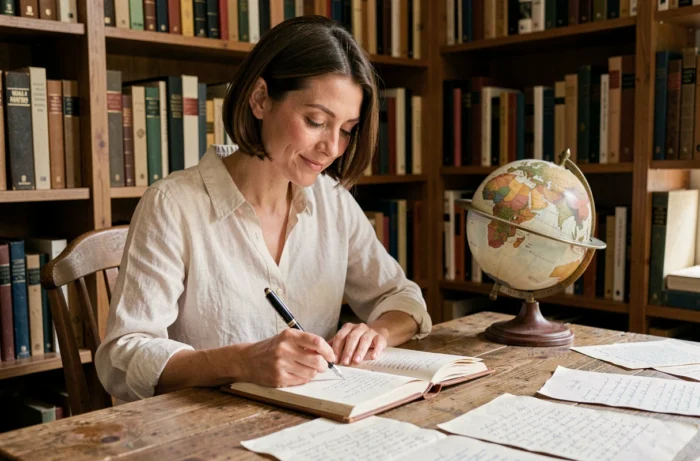
Narrative writing remains the most widely practiced format in French classes, from middle school to adult writing workshops. Related searches tend to revolve around the same request: concrete prompts, specific topics, and repeatable techniques for creating a story that holds the reader’s attention. The twenty examples below cover a range of styles (confession, suspense, memory, fantasy, chronicle), each highlighting a recognizable narrative device. They are springboards, not templates to copy.
1. A late-night confession in the first person
A character alone in a dark room recounts an act they regret. The nighttime setting creates immediate tension: the reader senses that speaking comes at a cost to the narrator. This device works because it combines an intimate voice with a gradual confession.
Baudelaire uses this technique in Le vin de l’assassin, where the guilty speaker’s words unfold in stages, blending guilt with provocation. To recreate this effect, begin with a short sentence that establishes the setting, then let the narrator reveal the facts in the disorder of their memory.
2. An autobiographical fragment in the style of Perec
In Je me souviens, Georges Perec strings together micro-stories of a few lines, each prompted by the same phrase. The device relies on selective memory as a narrative engine. Each fragment isolates an insignificant detail that, through accumulation, reconstructs an entire era.
This format suits writers who struggle with a blank page. Writing ten two-sentence fragments forces you to choose a precise sensory detail (a sound, a texture, the name of a discontinued brand) rather than summarize a period. Reading an example of narrative writing built on this principle helps you grasp the rhythm of deliberate repetition.
3. A story within a family conversation
Diderot opens L’entretien d’un père avec ses enfants with a story within a story: the father tells a moral anecdote while his children react. The reader follows two levels of narration at once, which renews their attention with every interruption.
To adapt this technique, place your main story in the mouth of a character speaking at the dinner table or in a car. The audience’s reactions (doubt, laughter, silence) become natural ways to build suspense.
4. An opening with a figure in motion
A little man walks along a path, a huge bag slung over his shoulders, moving furtively. This kind of opening, found in several literary short-story beginnings, poses a visual question before offering any explanation. The reader wants to know what is in the bag and why the man is afraid.
Describe an action before naming an emotion is the most effective rule for a narrative opening. Physical movement grounds the scene; the emotion follows, inferred by the reader.
5. The writer facing a blank page
A man sits in the dimmest part of his living room, with a ballpoint pen and a sheet of paper, drained of energy. This opening uses mise en abyme: the character cannot write, and the text we are reading is precisely about that failure.
This topic works well in a workshop because it turns the writer’s real-life block into narrative material. The constraint: never explain why the muse has left; only show the character’s actions (putting down the pen, staring at the wall, letting a tear fall onto the page).

6. An ordinary Saturday that takes a turn
A story that begins on an ordinary day (a Saturday, a trip to the supermarket, a bus ride) and then introduces a subtle disruptive element. The strength of this structure lies in the contrast between the carefully described routine and the arrival of an unusual detail.
The pitfall to avoid: introducing the turning point too late. Two paragraphs of everyday life are enough. Any more, and the reader may lose interest before the story begins.
7. The diary of a historical figure
Writing a fictional diary entry from the perspective of a real person requires you to combine storytelling with research. The story feels more credible when it mentions documented objects or places while inventing the character’s inner thoughts.
This format requires you to separate what can be verified from what is imagined. A good practice is to signal the boundary between fact and fiction within the text itself (through a detail or the narrator’s uncertainty).
8. A letter to your future self
The narrator writes to the person they will be in five years. This epistolary device creates a time shift that structures the story: each paragraph moves between taking stock of the present and imagining the future. The tone naturally wavers between hope and realism, giving the text depth.
9. A suspense story in a confined setting
A single location (a cellar, an elevator, a hotel room), two or three characters, and an object that concentrates the tension. The confined setting forces the writer to work with dialogue and silence rather than plot twists. Every gesture matters because there is nowhere to escape.
The spatial constraint also shapes the pace: sentences grow shorter as tension rises, and descriptions narrow to a single detail (a trembling hand, the sound of a lock).
10. A subverted moral tale
Take the structure of a fable (situation, transgression, consequence) and reverse the expected moral. The reader anticipates a conventional lesson, only to find an ambiguous conclusion. This technique works particularly well in a short story, where the ending carries the full weight of the narrative.
11. A childhood memory rooted in a specific place
A story that does not recount an entire childhood, but focuses on a single place: a grandmother’s kitchen, a vacant lot, a staircase. Limiting the setting to a small space forces you to enrich it with sensory details (the smell of wax, the sound of tiles, light from a window). The memory becomes tangible instead of remaining sentimental.
12. Real-time interior monologue
The narrator describes what is going through their mind during an ordinary activity (waiting for a bus, standing in line). The text unfolds without a plan, through associations. This format requires careful attention to sentence rhythm: short when attention is caught by a stimulus, long when the mind wanders.
The main risk is self-indulgence. Setting a length limit (one page, no more) keeps the monologue from becoming an endless exercise in introspection.
13. A fantasy story with a single supernatural element
A realistic setting, one impossible detail (a reflection that does not follow the movements, a door that opens onto a room missing from the floor plan). Restraint is what distinguishes successful fantasy from a catalogue of wonders. The reader shares the character’s doubts because everything else in the setting is ordinary.
14. A neighborhood chronicle across a season
A narrator observes the residents of a street or apartment building over three months. Each scene is brief (an exchange at the market, a move, a lost dog). The narrative progresses through juxtaposition, without a central plot, but one thread keeps returning (a character glimpsed in every scene, a recurring sound).
This format suits those who prefer observation to invention. However, it requires careful selection of the scenes to include to avoid a catalogue-like effect.
15. A story told in alternating voices
Two or three characters recount the same event, each in their own section. The contradictions between their accounts create tension. The reader pieces together the truth by comparing them.
This device requires each voice to have a distinct vocabulary. If all three narrators use the same turns of phrase, the polyphonic effect disappears. One simple approach is to give each character a different register (colloquial, formal, technical).
16. A travel anecdote built around a misunderstanding
A linguistic or cultural mix-up during a trip provides both the comic premise and the narrative structure. The story unfolds in three stages: the initial situation (the traveler thinks they understand), the misunderstanding (they act on a false interpretation), and the resolution (they discover their mistake).
17. A working portrait of a craftsperson or trade
Instead of describing a character by their appearance, show them at work. A baker shaping dough, a painting restorer scraping away varnish. Professional gestures reveal character better than a list of psychological traits.
This type of narrative writing calls for a period of observation (or research) to ground the story in authentic details: the name of a tool, how long a step takes, the body’s posture.
18. An exchange of letters between two strangers
Two characters exchange letters after an event connects them (an accident, a found object, a misdelivered letter). Each letter moves the story forward while revealing its author’s character. The format imposes a useful constraint: each character knows only what the other has chosen to write.
19. A narrative built around a single object
A story whose central thread is an object (a watch, a notebook, a key) that passes from hand to hand or is found again years later. The object structures the transitions in time and justifies the ellipses. The reader follows the object, not a character, making it possible to move across several eras without losing coherence.
20. Reworking a news story as a literary short story
Start with a real event reported in a few lines in a newspaper and turn it into a fully developed story. Used by many French-language writers, this technique requires you to fill in the factual gaps with imagination while respecting the original framework.
Elements to decide on before writing:
- The chosen point of view (witness, protagonist, investigator) and how it affects access to information
- The precise moment when the story begins, which is not necessarily the chronological start of the event
- The invented detail that gives the text its literary dimension, distinct from verifiable facts
These twenty prompts cover distinct styles and writing constraints. The underlying principle is the same: a limited framework (place, object, voice, duration) produces a denser story than an open-ended topic. Choosing a specific constraint before you begin is often what separates a compelling narrative from a draft that goes around in circles.