
Around the world travel is not just about ticking names off a map. The choice of a destination is based on concrete criteria: accessibility, entry requirements, climate, cost of living on-site, and the density of sites to explore within a limited area. Some regions of the globe concentrate a diversity of landscapes and cultures over short distances, making them particularly suitable for a multi-stop itinerary.
Entry Requirements in Europe: What Changes with the ETIAS System
Most destination rankings present Europe through the lens of landscapes and gastronomy. They overlook a regulatory evolution that will change access conditions for many travelers.
The ETIAS system (European Travel Information and Authorization System) will affect visa-exempt travelers visiting around thirty European countries. It is a digital authorization linked to the passport, with fees set at 20 euros by the European Commission. The authorization should remain valid for up to three years, or until the passport expires.
The deployment schedule remains unstable. No applications are currently being collected, and the launch date must be announced several months in advance. At the same time, the European Entry-Exit System (EES) has begun its gradual rollout starting in October 2025, with increasingly digitized and biometric border controls. To plan a European stay, resources like travel-destination.net allow you to track these developments before booking.
The practical consequence: checking entry requirements a few weeks before departure becomes a crucial step in the preparation, even for countries that previously required no prior steps.
Southeast Asia Destinations: Cultural Density Over Short Distances
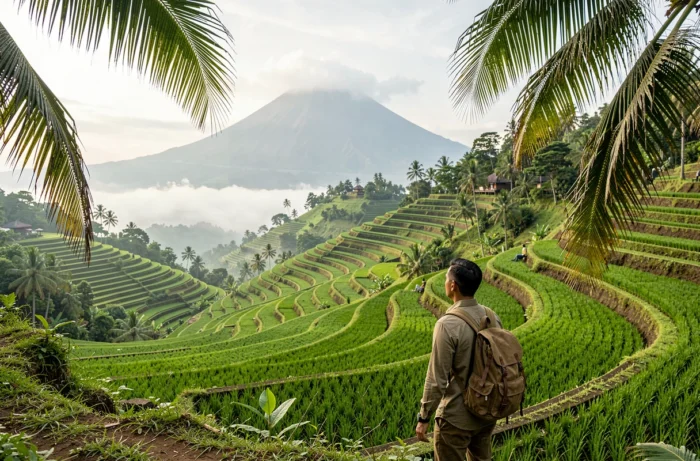
Southeast Asia remains one of the areas where the ratio of cultural wealth to geographical proximity is most favorable. In just a few hours of domestic flight or bus, a traveler can go from ancient temples to terraced rice fields, and then to beaches lined with turquoise waters.
Vietnam, from North to South
Vietnam concentrates an unmatched variety of landscapes within its elongated territory. The less-visited Tu Long Bay (compared to its neighbor Ha Long), the ancient imperial cities of Hue, the alleys of Hoi An, and the Mekong Delta create an itinerary that blends history, nature, and daily life.
The cost of living on-site remains among the lowest in Asia, allowing for an extended stay without breaking the budget. Entry requirements vary by nationality, but many countries benefit from visa exemptions for short stays.
Indonesia Beyond Bali
Bali attracts the majority of travelers, but the Indonesian archipelago comprises thousands of islands with radically different profiles. The rice fields of Jatiluwih (a UNESCO World Heritage site) offer a sculptural landscape that most visitors to Bali never see. Further east, Raja Ampat is home to one of the richest marine biodiversities on the planet.
The interest of an Indonesian itinerary lies in this juxtaposition of biomes within the same archipelago: active volcanoes, tropical forests, exceptional underwater landscapes, and distinct local cultures from one island to another.
South America: Altitude, History, and Climatic Contrasts
South America is distinguished by its altitude contrasts. In just a few hundred kilometers, a traveler goes from sea level to several thousand meters, with changes in vegetation, temperature, and culture at each level.
Peru, from the Coast to Machu Picchu
Peru remains one of the destinations with the highest concentration of historical density. Machu Picchu, perched in the Andes, is a site that most travelers consider significant. The classic itinerary (Lima, Arequipa, Colca Canyon, Cusco) allows for an understanding of the overlap of civilizations, from the Inca Empire to the Spanish colonial period.
A often overlooked point: acclimatization to altitude is crucial for a successful stay. Arriving directly in Cusco without an intermediate stop exposes one to altitude sickness. Allowing two days for adaptation at a moderate altitude (Arequipa, for example) dramatically changes the comfort of the trip.
Argentinian Patagonia and the Perito Moreno Glacier
At the southern tip of the continent, Patagonia offers glacier, steppe, and mountain landscapes that have no equivalent elsewhere. The Perito Moreno Glacier, in particular, is one of the few glaciers in the world still advancing. Watching its ice blocks break off into the lake is as much a sound experience as a visual one.
Patagonia imposes logistical constraints: distances between sites are long, infrastructure remains limited off-season, and the wind can make certain hikes challenging. It is a destination that requires preparation based on the southern season.
Southern Africa: Wildlife and Desert Landscapes
Namibia regularly appears in destination rankings, often reduced to its red dunes. Its appeal goes beyond that. The Namib Desert is considered the oldest in the world, and its geological formations (Sossusvlei, Deadvlei) create landscapes whose colors change depending on the time of day.
The other Namibian asset is the wildlife observable in Etosha National Park, one of the largest parks in Africa. Unlike some East African safaris, the park can be explored independently, in a personal vehicle, which significantly reduces the cost of the stay.
- Sossusvlei for the dunes and landscape photography, ideally at sunrise
- Etosha for wildlife observation around water points, especially in the dry season when animals concentrate
- The Atlantic coast (Walvis Bay, Swakopmund) for seal colonies and activities in the coastal desert environment
Namibia remains a country where tourist density is low relative to its area. This characteristic preserves the quality of the experience but requires careful planning of stops: distances between accommodations are often measured in hundreds of kilometers on dirt roads.
Choosing a destination around the world comes down to balancing depth of immersion and diversity of stops. An itinerary that combines two or three distinct geographical areas, with enough time at each site to go beyond mere visiting, generally produces more lasting memories than a whirlwind tour of ten countries in three weeks.