Fifty hectares is 500,000 m², or exactly 0.5 km². The figure seems abstract until it is related to familiar benchmarks. This article provides concrete, measurable equivalents to give a tangible dimension to this area that we encounter in real estate listings, development projects, or urban planning documents.
50 hectares in linear dimensions and surface units
| Unit | Equivalent for 50 ha |
|---|---|
| Square meters (m²) | 500,000 m² |
| Square kilometers (km²) | 0.5 km² |
| Ares | 5,000 ares |
| Side of an equivalent square | About 707 meters |
The last line of the table is the most telling. A square with 707 meters on each side represents a distance that can be walked in eight to ten minutes at a normal pace. Walking the entire perimeter of this square, which is about 2.8 km, would take a good half hour.
To deepen these visual benchmarks, you can find the area of 50 hectares according to Immobilier du Net with other useful comparisons applied to daily life.
Football fields and urban parks: comparing 50 hectares to known spaces
A standard football field (approximately 105 m by 68 m) covers about 7,140 m². In relation to 50 hectares, this equates to about 70 football fields lined up. The image is striking: seven rows of ten fields end to end would barely cover the area.

When comparing 50 hectares to parks frequented by city dwellers, the scale changes. The Luxembourg Garden in Paris, for example, covers an area well below 50 hectares. Central Park in New York far exceeds this threshold. Fifty hectares thus lie between a large downtown park and a metropolitan green space.
Why the football field remains the best benchmark
Most people have seen a football field in person. The rectangular lawn provides an immediate mental framework. Saying “70 fields” conveys both the length (over 7 km if lined up) and the width, which the mere square meter figure does not allow.
50 hectares in an urban development project: an entire neighborhood
Fifty hectares do not represent just a simple building lot. On a city scale, 0.5 km² is enough to accommodate a complete neighborhood with its streets, housing, shops, and green spaces. The Honeysuckle development program, cited by UN-Habitat, illustrates this reality: a 50-hectare site transformed into a vibrant neighborhood with 5 kilometers of waterfront and a waterside promenade.
This type of project shows that land of this size far exceeds the agricultural framework often associated with the hectare. Fifty hectares is the threshold at which a developer can design a self-sufficient piece of city, with transportation infrastructure, public facilities, and significant residential density.
Agriculture, forest, urban planning: three perspectives on the same area
The perception of 50 hectares varies radically depending on land use. To better grasp the differences, here are three common contexts:
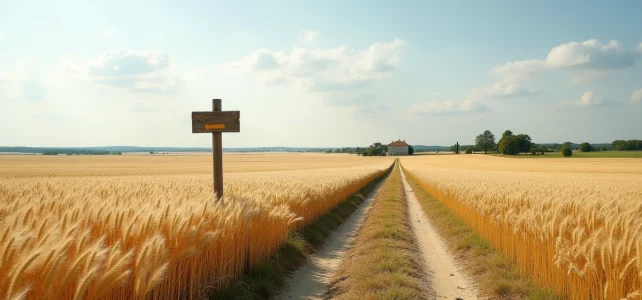
- Agricultural operation: 50 hectares correspond to a medium-sized grain farm in France. An operator can grow wheat or rapeseed on a single mechanized plot, which already represents a full-time activity.
- Private forest: a 50-hectare forest plot constitutes a sufficient domain to consider structured forestry management, with scheduled cuts over several decades and a reforestation plan.
- Urban area: in a suburban municipality, 50 hectares can house several thousand residents if the density reaches that of a typical residential neighborhood.
The same half-square kilometer thus produces very different realities depending on whether one plants wheat, oaks, or buildings.
Quick conversion: from 50 hectares to other measurement units
The basic formula remains multiplication by 10,000. One hectare equals 10,000 m², so 50 hectares equal 50 × 10,000 = 500,000 m². To convert to square kilometers, divide by 1,000,000: the result is 0.5 km².
For areas expressed in ares (a unit still common in notarial deeds), simply multiply by 100. Thus, fifty hectares yield 5,000 ares, or 500,000 centiares (one centiare equals one square meter).
- 50 ha = 500,000 m² = 0.5 km²
- 50 ha = 5,000 ares = 500,000 centiares
- Side of the equivalent square: about 707 m (square root of 500,000)
- Perimeter of the equivalent square: about 2,828 m
These conversions are useful whenever reading a cadastral document or a real estate listing mentioning hectares without other visual benchmarks. On a municipal zoning plan, 50 hectares often represent the size of an AU zone (to be urbanized) in the PLUs of medium-sized towns, which helps to relate the figure to a document that elected officials and residents consult regularly.
Remember that 50 hectares occupy half a square kilometer is sufficient in most situations. This equivalence anchors the area in a geographic scale readable on any map, where the figure of 500,000 m² remains difficult to visualize without additional calculation.