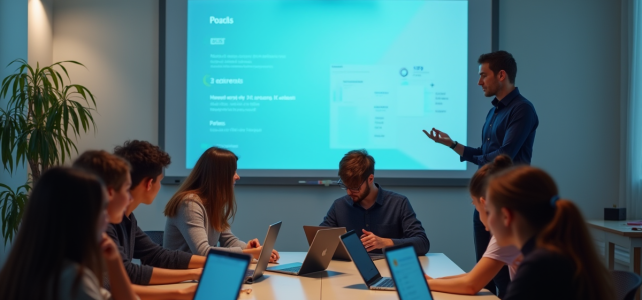
Twenty-first-century teachers face demanding challenges and require appropriate resources to meet the varied needs of their students. With the rapid evolution of technologies and teaching methods, they must constantly adapt to provide quality education.
To optimize their teaching and capture their students’ attention, these professionals now have a range of innovative tools at their disposal. From digital platforms and interactive applications to modern educational materials, teachers are better equipped than ever to transform learning into a dynamic and engaging experience.
Related reading : Online Tools for Renovation Enthusiasts: Which Ones to Choose?
Essential Skills for Twenty-First Century Teachers
In a world in constant flux, teachers must develop specific skills to ensure quality education. The learning and innovation skills, often referred to as the 4 Cs of 21st-century education, form the foundation of this transformation. They encompass critical thinking, problem-solving, creativity, innovation, communication, and collaboration.
This approach is validated by the World Economic Forum. Its 2020 report on the future of jobs identifies these skills as vital for the next decade. Indeed, creativity, cognitive flexibility, complex problem-solving, judgment and decision-making, negotiation, and people management are among the ten most sought-after skills by employers.
You may also like : Essential Beauty Trends to Embrace for Elevating Your Online Style
Integrating New Skills into Pedagogy
The COVID-19 pandemic revealed the need for rapid adaptation to digital tools. Teachers must not only master these technologies but also develop their emotional intelligence to better interact with their students remotely. Tools like the AC Montpellier webmail facilitate this transition by providing suitable communication and classroom management platforms.
- Critical thinking: Analyzing and evaluating arguments and evidence.
- Problem-solving: Finding innovative and effective solutions to complex challenges.
- Creativity: Imagining new and original approaches.
- Communication: Conveying ideas clearly and effectively.
- Collaboration: Working as a team to achieve common goals.
Twenty-first-century teachers must therefore engage in a process of continuous development of their skills. They need to familiarize themselves with modern methodologies and remain open to innovation to meet the demands of their educational mission.
Technological Tools for Modern Teaching
Digital tools are radically transforming teaching methods. Teachers today have access to collaborative platforms, online learning software, and interactive devices that facilitate the transmission of knowledge. Their use creates a digital environment conducive to collaborative learning and project-based learning.
Collaborative Platforms
Collaborative platforms such as digital work environments (DWE) provide teachers with the ability to manage courses, assignments, and communications with students and parents. They often integrate video conferencing tools, discussion forums, and shared storage spaces.
Online Learning Software
Online learning software allows for the personalization of educational pathways. They rely on artificial intelligence algorithms to offer content tailored to each student’s level and pace. These tools enhance the process of formative assessment and facilitate progress tracking.
Interactive Devices
Interactive whiteboards and tablets have become common equipment in modern classrooms. They allow for the introduction of multimedia elements into lessons, making classes more dynamic and engaging. These devices also encourage interaction and collaboration among students.
- Digital work environments: Course and communication management.
- Online learning software: Personalization of educational pathways.
- Interactive devices: Energizing lessons and increasing interaction.