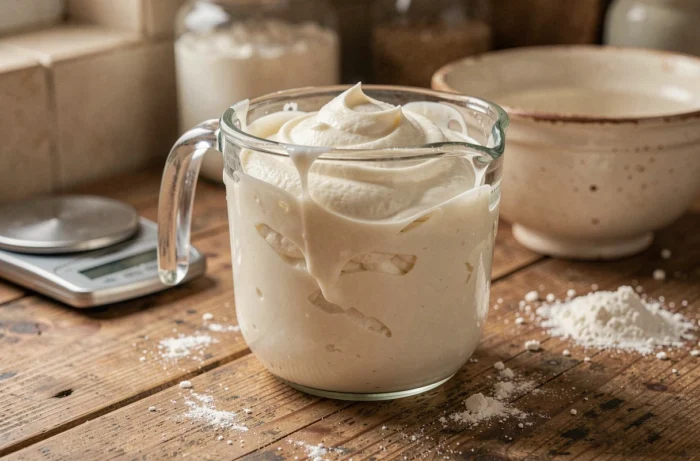
Thick cream is not water. Applying the ratio of 1 cl = 1 g without correction introduces a weighing error that, in pastry, is enough to alter the texture of a batter or the consistency of a ganache. The conversion of 20 cl of thick cream into grams depends on a variable that most public tables ignore: the density varies according to the fat content of the product.
Actual density of thick cream: how fat content changes things
The density of thick cream ranges between 1.00 and 1.05 g/ml. This range may seem narrow, but over 200 ml, it can represent a difference of up to 10 g, equivalent to a well-filled tablespoon.
A full cream with 30% fat contains more lipids, which are less dense than the aqueous phase. Its density is therefore closer to 1.00. Conversely, a light cream with 15% fat retains a higher proportion of water and shows a density closer to 1.05.
In practice, 20 cl of full thick cream weighs about 200 g, while 20 cl of light thick cream can reach 205 to 210 g. This distinction does not appear in any standard conversion table, which treats cream as a homogeneous ingredient.
A reliable reflex is to check the net weight indicated on the packaging. A pot of light thick cream at 15% sold in 20 cl shows a net weight distinct from the volume, confirming that the manufacturer itself does not consider the 1:1 ratio to be accurate.
This net weight printed on the label is the most precise reference, as we can find the exact conversion of 20 cl of thick cream into grams on Yummy Blog with details by type of thick preparation.
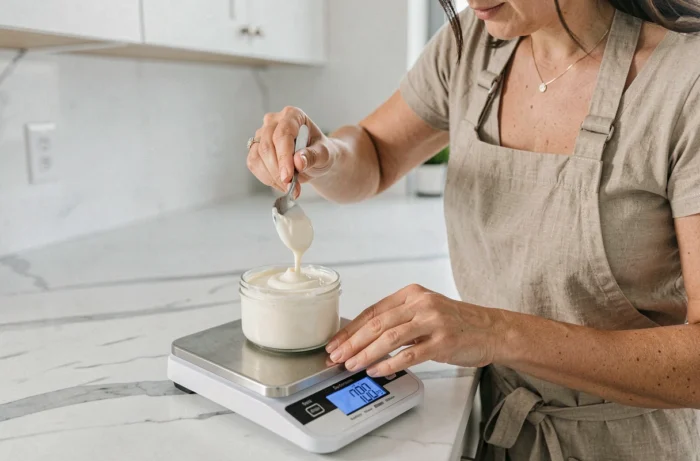
Thick cream conversion without a scale: reliable measuring methods
The absence of a scale does not exempt one from rigor. Three approaches allow for an accurate mass estimation with common tools.
- The graduated measuring cup in milliliters remains the most suitable tool. Thick cream does not flow like a liquid: we recommend pressing it down slightly with a spatula to eliminate air pockets, then reading the measurement at eye level, including the meniscus.
- The calibrated tablespoon holds about 15 ml of thick cream. Thirteen well-filled tablespoons approach 200 ml, but the cumulative margin of error makes this method acceptable only for tolerant recipes (sauces, soups).
- The commercial pot serves as a direct measure. An emptied 20 cl pot corresponds exactly to the required volume, and the net weight on the packaging gives the mass without any calculation.
The tablespoon is not suitable for precision pastry. The cumulative error over thirteen tablespoons can reach 15 to 20 ml, nearly 10% of the total volume. For a diplomat cream or a cheesecake, the scale or measuring cup remains the only reasonable tools.
Thick cream and liquid cream: why the conversion differs in cooking
Thick cream has undergone maturation through lactic fermentation. This process alters its viscosity, structure, and behavior when measuring. Liquid cream, which is not fermented, pours and levels naturally in a graduated container. Thick cream, on the other hand, forms air pockets and clings to the walls.
In terms of pure density, the difference between the two remains modest at the same fat content. The real difference lies in the precision of volumetric measurement. Pouring 20 cl of liquid cream into a measuring cup yields a repeatable result. Transferring 20 cl of thick cream consistently leaves a residue in the pot or on the spatula.
In professional kitchens, we observe that this residue represents between 5 and 10 g of product lost. To compensate, there are two options: carefully scrape the container with a spatula, or weigh the cream directly in the mixing bowl while taring the scale.
Temperature and behavior of thick cream
Thick cream taken out of the refrigerator is more viscous and harder to measure. At room temperature, it slightly thins and pours better into a graduated container. This does not significantly alter its density, but improves the accuracy of volumetric measurement by about 3 to 5% compared to cream at 4 °C.
Thick cream conversion table: common volumes and masses
Rather than a universal table for all ingredients, here are the specific correspondences for thick cream, distinguishing the fat content.
| Volume | Full thick cream (30% fat) | Light thick cream (15% fat) |
|---|---|---|
| 5 cl | about 50 g | about 52 g |
| 10 cl | about 100 g | about 105 g |
| 20 cl | about 200 g | about 205-210 g |
| 25 cl | about 250 g | about 260 g |
These values are based on the documented density range (1.00 to 1.05 g/ml). They remain approximations: the net weight on the packaging always takes precedence over a generic table.
Common errors in converting centiliters to grams for cream
Three errors frequently recur and deserve to be pointed out.
The first: confusing thick cream and liquid cream in a recipe. Substituting one for the other at the same weight alters the dish’s texture, as the water content and viscosity differ. A quiche made with 200 g of liquid cream instead of 200 g of thick cream will be more fluid before cooking and less creamy afterward.
The second: neglecting incorporated air. Whipping thick cream before measuring increases its apparent volume without changing its mass. Always measure the cream before any mechanical manipulation.
The third: systematically rounding to 200 g regardless of the product. For a light cream, this habit underestimates the actual mass and can skew the balance of a recipe where proportions are tight.
The safest gesture remains to weigh directly to the nearest gram. If not, reading the label on the pot and cross-referencing with the indicated volume allows for obtaining the exact density of the product you have on hand, without relying on a standardized table.